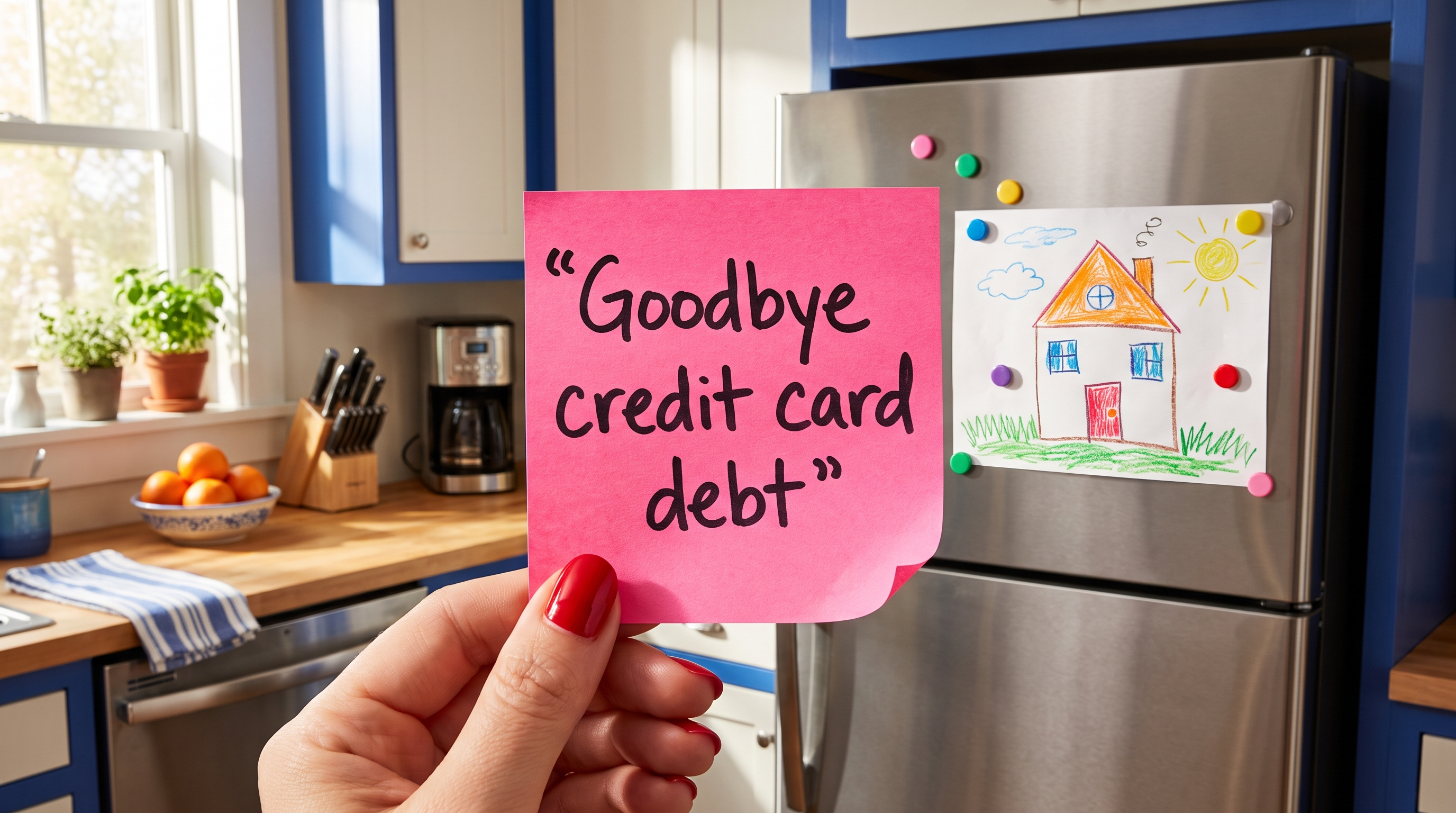
Meet Allison R. (name changed to protect client privacy). After her divorce, she had to rebuild everything at once — a new place to live, new furniture, a new routine on one income. Credit cards covered the gap. Within a year, she was making minimum payments every month and getting nowhere.
That story isn't unusual. Across the country, credit card debt is quietly piling up for people who never expected to carry it.
Balance stuck, too? See your debt consolidation options →
It's Not Just You — And It's Not About How Much You Earn
Falling behind on credit cards has less to do with how much you make and more to do with what life throws at you. A divorce, a layoff, a medical bill, even a few slow months — any of it can push a manageable balance into one that grows faster than you can pay it down.
Debt of all kinds happen at every income level and every credit score range. Plenty of people with good credit and steady paychecks are still stuck making minimum payments every month, watching the balance barely move, or falling behind on medical debt or personal loans.
Has any of this happened to you lately?
Tap any that apply.
Checking is a soft pull and won't affect your credit score. Applying may need a hard pull.
Why "Just Paying The Minimum" Can Quietly Trap You
Here's the part most people don't realize: your minimum payment isn't designed to pay off your debt. It's usually calculated as a small percentage of your balance — often 1% to 3% — plus that month's interest, or a flat dollar amount, whichever is higher.
That formula can keep a balance around for years. Most of each payment goes toward interest first, and only a sliver chips away at what's actually owed — which is how a five-figure balance can stretch into a decade or more of payments.
By law, your statement's "Minimum Payment Warning" shows how long and how much paying only the minimum takes.
That's exactly what happened to Allison. She owed $11,596 on credit cards after her divorce. Paying only the minimum, she would have paid back $37,661 before the balance was gone — more than three times what she originally borrowed.
What Allison owed vs. what the minimum would cost
Minimum payments only, until paid off
What Allison owed$11,596
What she'd pay on minimums$37,661
More than 3×
Assumes a 17% APR and paying only the minimum until the balance is gone.

Ready to apply? Start your application with EvaFi →
There Is More Than One Way Out
The good news: minimum payments aren't the only option once debt starts to feel unmanageable. A few of the more common paths people use include:
Debt consolidation loans, which roll multiple balances into one loan, often with a lower interest rate and a single fixed payment.
Debt resolution plans, which negotiate directly with creditors to resolve the debt for less than the full amount owed.
Programs like these are built specifically for people in the minimum payment trap, not just people who are a little behind. Companies like EvaFi offer consumers the option to check if they qualify for both of these options without any impact to their credit score. Keep in mind, however, that a full application is a separate step beyond checking if you qualify, and that can involve a hard credit pull.
How much do you owe on your cards?
Checking is a soft pull and won't affect your credit score. Applying may need a hard pull.
What Happened To Allison
Allison enrolled in a debt resolution plan instead of continuing on minimum payments. Over 40 months, she paid back a total of $8,223 and was debt-free. Compared to the $37,661 she was on track to pay, that's $29,438 saved.
Allison's two paths
Total paid on her $11,596 balance
Minimum payments only$37,661
Debt resolution plan · 40 months$8,223
Minimum-payment total assumes a 17% APR. Results vary and aren't guaranteed. They depend on your debts, your creditors and finishing the plan.
Not sure which path fits you?
Compare offers from EvaFi's network of finance providers.
- Checking is a soft pull and won't affect your credit score. Applying may need a hard pull.
How it works: EvaFi isn't a lender. It connects you with options from its financial providers and may be paid by them. EvaFi may contact you about your options.
Is This You?
If you're making minimum payments and the balance never seems to move, it may be worth the sixty seconds to see where you stand.
Try this: the 30-second check
Compare the balance on your last two statements.
Same or higher? Check your options →
Your next step
Discover what offers are available to you through EvaFi's trusted network of finance providers.
Checking is a soft pull and won't affect your credit score. Applying may need a hard pull.
See my optionsSources
- Federal Reserve Bank of New York, Household Debt and Credit Report, Q2 2026 ($1.26 trillion)
- TransUnion, Q2 2026 Credit Industry Insights Report ($6,610 average card debt per borrower)
- Federal Reserve Board, G.19 Consumer Credit (22.15% average APR on accounts assessed interest, Q2 2026)
- "Minimum Payment Warning": Regulation Z, 12 CFR 1026.7(b)(12)
- CFPB, The Consumer Credit Card Market (report), October 2023, p. 41 (minimum payments typically 1% to 3% of the balance plus interest and fees, or a flat floor)
- Allison's figures: CountryWide Debt Relief, Proven Results, Client #17299 (used with permission)